UNDERSTANDING HEARING LOSS
Hearing loss is a reduction in your ability to hear sounds clearly. It can affect one or both ears and range from mild difficulty hearing certain sounds to more significant challenges in following conversations in daily life.

HOW YOUR EARS CAPTURE SOUND
The human ear is a complex and delicate system that plays a crucial role in our ability to hear and process sound. From the outer ear to the inner ear, each component works together to capture and transmit sound vibrations to the brain.
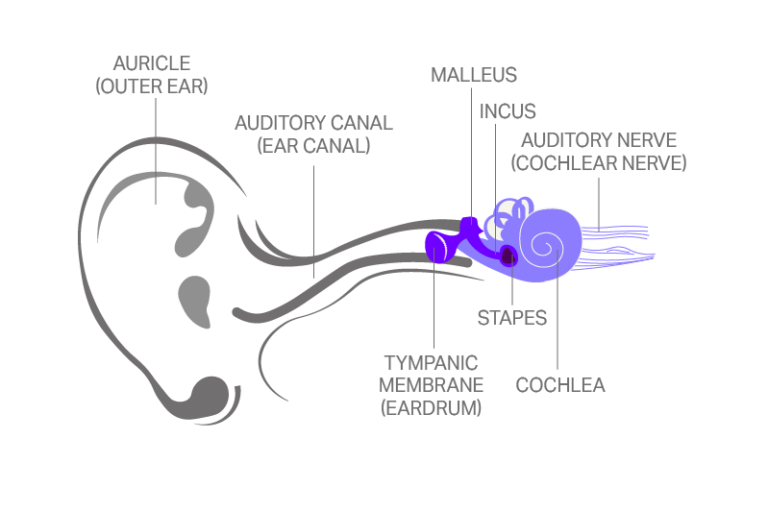
The ear has three parts:
-
Outer Ear
The outer ear consists of the pinna (the visible part of your ear) and the ear canal. The pinna picks up sound, and the ear canal acts like a funnel that amplifies sound waves and delivers them to the eardrum. When the sound waves reach the eardrum, they cause it to vibrate, which sets off a chain reaction in the middle ear.
-
Middle Ear
A chain of three tiny bones is attached to the other side of the eardrum. These bones are called the malleus, incus, and stapes (hammer, anvil, and stirrup), and together they are known as the ossicles. When the eardrum vibrates, it causes the chain of ossicles to move, amplifying the vibrations and passing them from the eardrum to the inner ear.
-
Inner Ear
The part of the inner ear which processes sound is called the cochlea. This snail-shaped organ contains thousands of specialised cells called hair cells, which convert the movement of the middle ear ossicles into electrical signals. The auditory nerve then transmits these signals to the brain, which interprets the sound into what we hear. Then, your brain analyses the acoustic scene to help you identify sounds and voices.
RECOGNISING THE SIGNS OF HEARING LOSS
Hearing loss often develops gradually, which makes it difficult to notice at first. Many people begin to experience:
-
- Difficulty understanding speech, especially in noisy environments
- Conversations sounding unclear or muffled
- Frequently asking others to repeat themselves
- Trouble following group discussions
- Feeling that others are mumbling
Because the change can be subtle, people around you may notice the signs before you do.

UNDERSTANDING DIFFERENT TYPES OF HEARING LOSS
Often, people with all types of hearing loss struggle to hear soft sounds and high-pitched sounds such as whispers, children’s voices, or birdsong. However, the type of hearing loss a person has can influence how their hearing is affected. There are three main types of hearing loss:
-
Conductive Hearing Loss
Conductive hearing loss occurs when sound is prevented from reaching the inner ear at full strength.
-
Sensorineural Hearing Loss
Sensorineural hearing loss is caused by damage to the inner ear (cochlea) or the nerve pathways that transmit sound from the ear to the brain.
-
Mixed Hearing Loss
Mixed hearing loss is a combination of conductive and sensorineural hearing loss. This means that there is a problem in both the outer or middle ear and the inner ear or nerve pathways.
HOW MUCH NOISE IS TOO MUCH?
Sound intensity is measured in decibels (dB). While normal conversation is considered safe, prolonged exposure to sounds above 85 dB can damage hearing over time.
Very loud sounds, such as concerts, machinery, or sudden explosive noise, can cause immediate and permanent damage.
Noise-induced hearing loss happens gradually and is irreversible. Protecting your ears in loud environments is essential for long-term hearing health.
EARLY ACTION MAKES A DIFFERENCE
Hearing loss can affect communication, social interaction, and overall quality of life. Because it often develops gradually, many people delay seeking help.
A professional hearing evaluation can determine the type and degree of hearing loss and help identify appropriate next steps.
At BestSound stores, our experts conduct comprehensive assessments to understand your hearing profile and guide you toward suitable solutions.